Showing posts with label tika-ti. Show all posts

King of the Mountain

"King of the Mountain" is a very fun rhythm practice game that I learned from Lamar Robertson when I very first started teaching.  Of course, I started trying to implement it without having all my Kodály levels and I have since refined the way I teach it.  

Here are the basic concepts of the game:
Formation: 
students are seated in a circle, with “King of the Mountain” cards in front of them (folded in half and propped up like a tent- this enables the student to see their card and for players on the other side of the circle to see the card as well)
Action:

  1. One student is designated the King/Queen.  The person to the King’s right is the next highest player on the mountain (one position lower on the mountain than the king); the person to that person’s right is the one position lower etc., all the way around the circle with the player to the king’s left being the lowest player on the mountain. In other words, as you progress around the circle from the king’s right, you go “down” the mountain (you get lower and lower on the mountain).  The goal of the game is to work your way up to the top of the mountain and be in the king’s position.
  2. The king starts the play by reading his/her card, with a steady beat.  Without missing a beat the king must then read another player’s card.  The player who’s card is read must then read their card and then another player’s card and so on until someone makes an error.   The rhythms on the card must be read with a steady beat and without missing a beat.
  3. If a player makes a mistake (for example, misses a beat, reads a rhythm wrong, says their card out of turn) that player goes to the bottom position on the mountain (the seat to the king’s right) and all players “lower on the mountain” that that player advance up a position.  ** THE CARDS ARE FIXED IN THEIR POSITION- THE CARDS DO NOT MOVE, only the players change position.  The king starts the play again, once everyone has changed position.
  4. The end of the game is determined by the length of time the teachers wants to designate to the game.
To make this more difficult:
  1. Have students must clap their rhythms, in addition to saying them.  This is much harder then just saying their rhythms.
  2. To “Up the Ante”, have students clap only their rhythms.  
  3. Instead of using standing cards, cut the cards in half and have the students read the cards from the floor.  This challenges students to read cards on the other side of the room that are upside down and backwards- this is a higher level thinking task.  But, this is also visually harder with large groups


As I mentioned before, when I first started I had no clue as to what I was doing.  I had every rhythm imaginable in the game and it was a mess.  I redid them a few years ago and really used them to focus on practicing a specific rhythmic element.  Those cards have been starting to  look pretty bad so I recently made new versions of the games, here are some examples of four Syn-co-pa cards:


I'm going to print them out on card stock and then they will be folded along the dotted line so that they stand up.  

You can find the following sets on my Teachers Pay Teachers page:
  1. Tika-Tika
  2. Ti-tika 
  3. Tika-ti
  4. Syn-co-pa
  5. Tom-ti
  6. Ti-tom
  7. Tim-ka
  8. Ti-kam
Additionally,  I have made some glynniss' games that I will be posting at my TpT store and will be writing a blog post about tomorrow.  If you follow Aileen Miracle's AMAZING blog, you'll see that she posted about this yesterday and she has some "I have/Who has" files at her store (and she has a freebie!).  Make sure you follow her, both on her blog and at her TpT store, she has some great ideas!!! 

Have a great weekend everyone!

4

Up On The Housetop

It's hard to believe that Thanksgiving has come and gone already!  I don't know about your schedules but our district has 3.5 weeks until Winter break.  With three school choir performances between then and now I already have my tree up, the lights hung outside, most of my kids' presents purchased and have been listening to Christmas songs for the past few days.  Sad, I know!  

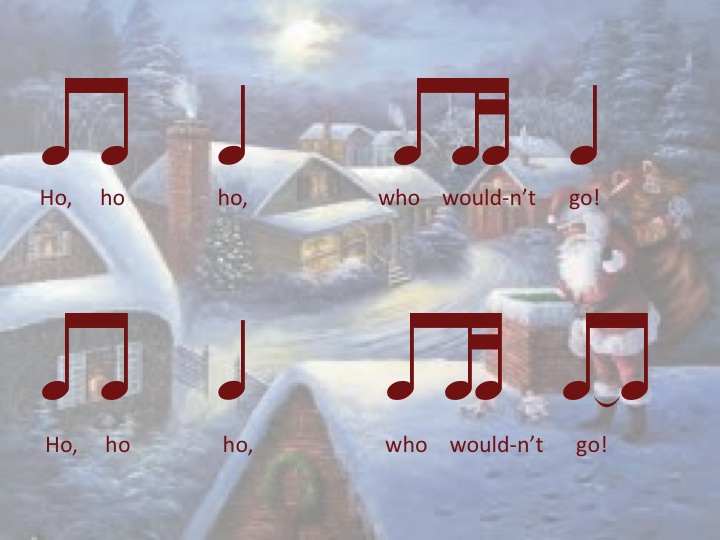
Well, since I have caught the holiday spirit and because one of the teachers in my district recently asked me if I could recommend any Christmas songs that use ti-tika and tika-ti I thought I'd share a PowerPoint and solfa-mix-up game that I created over break.  I did find a few Christmas songs that use ti-tika and tika-ti, including "Up On The Housetop."  Now, the notated version I have of this song is written in augmentation of the way I have it notated.  This goes back to my Kodály levels with Jill Trinka; she wanted us to notated songs the way we sing it and I think this lends itself to the way I have it notated below:


Of course there are two more verses.  These two are included in the PowerPoint slide below:


My third graders are prepping ti-tika, and we will present it in the next week.  We will start by reading this slide that uses a tie in the sixteenth notes.  We talk about the critical attributes of this rhythmic element: it is three sounds on one beat, the sounds are uneven and the sound organization is long-short-short.

If you have older beginners and are choosing to present ti-tika and tika-ti at the same time you could use this slide as well (although, my choice is to prepare and present each of these rhythmic elements individually):

Once ti-tika is presented, my 3rd graders will read the slide with this notation:

Here's the tika-ti prep slide, if you're prepping tika-ti:

And you could always have your 4th and 5th graders read the following rhythmic notation for practice:


The verse of this song is excellent do-pentatonic practice for 3rd-5th graders:


If you have gotten to fa with your 4th graders they could also read the chorus on solfége:


Here are some flashcards with rhythmic and melodic patterns from the song:

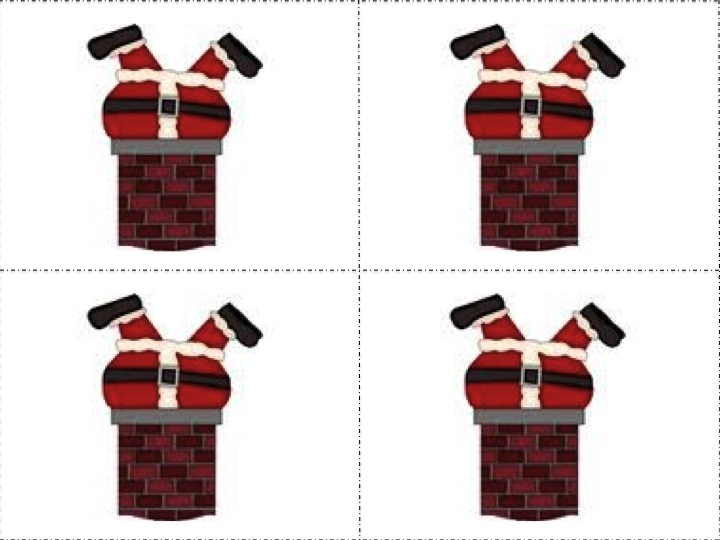
One of my professional goals this year is to incorporate more solo/small group work.  I'm planning on using this as an assessment.  On one side of the card I will print the Santa's that are stuck in the chimney and on the other side will be the rhythm/solfa.  For 3rd grade, each student will receive 4 cards (the fronts with the Santas and the back with the patterns from the verse) and for 4-5 grades, each student will receive a total of 8 cards (the fronts with the Santas and the backs with the patterns from both the verse and the chorus).  The object is to put the cards in the order of the song.


If you would like a copy of this file, I have uploaded it to Teachers pay Teachers and you can access it by clicking here.

I hope you all had a GREAT Thanksgiving!!
3

Pick-a-Pick-a-Pumpkin

I'm on a Halloween kick.  What can I say, I LOVE THIS HOLIDAY!!  And it seems that in every post I say "here's a fun one," so guess what?  Here's another one!

I'm not sure where or who I learned this from.  I know my mom sings it with her kids and when I student taught with Cindy McCaskill I recall her doing a song similar to this one, but I don't think it's the same one.

So, without further adieu, here's the song:


I save this game for my older kids.  Rhythmically, my 4th and 5th graders can read it: the most advanced rhythm is tika-ti.  I *sometimes use this with 3rd grade but I like to hold onto it for my older students.  Melodically, we don't do much with it.  I haven't gotten to ti with my 5th graders at this point in the year so we can't extract the phrases that have ti in it.  There are a couple spots that are extractable (measures 1-2, 9-10, 13-14) but to be honest, I use it only for rhythmic practice/reinforcement of tika-ti.

Here's the game:

Formation:  standing circle
Action:

  1. Before teaching this game we spend a lesson practicing a bouncing pattern with a playground ball to the beat of the song.  We bounce on beat one and catch on beat two.  
  2. At the second lesson we review bouncing on beat one and catching on beat two.
  3. We then try passing the ball on the bounces, with the neighboring student catching the ball.  This continues all the way around the circle until it gets back to the teacher.  While doing this for the first time, we do not sing the song.  Instead we say "bounce, catch, bounce, catch. . . ." until the ball has made it all around the circle.  I have the students keep the pattern going even when they don't have the ball by patting their laps when the ball is bounced and clapping their hands when the ball is caught.
  4. We then add the song.  Before we begin "competative play" we do a practice round so students can practice the beat passing pattern while singing the song.  When play begins the student who catches the ball on the last beat of the song is "out."  From here there are two ways to continue the play:
    1. The "out" student starts a new circle with a different playgound ball and all the "outed" students join that circle.
    2. The "out" student sits down where they are.  The "outed" student continues to keep the steady beat pattern (pat-clap) OR they keep the rhythm on sticks.  When I know that eventually everyone is going to be playing sticks I have the students use chop sticks.  This keeps the stick volume under control and not over-powering the singing.  This way is more challenging because as students are eliminated they have to bounce the ball past the seated students.  In all honesty, it's a good test of their physical skills, more then their musical skills.  But it's a way of "kicking it up a notch."

A few years ago I found these balls at King Soopers (our local Kroger store):
This year I saw that Kings still has them and you can also find them at Safeway.  They run about $6.00 each.  The little kids like to have them out when we sing "5 Little Pumpkins".  Last year they had mini pumpkin playground balls but I didn't see them anywhere this year.  If you're working on la right now you could use them with "Bounce High, Bounce Low" or "Plainsies, Clapsies".  You could also use them with "Miss, Miss." 

Happy beat passing! :)
0

Rhythm Blocks

Last month I posted about rhythm and solfa blocks.  I used both wood and foam blocks for those and I mentioned that I found the foam blocks at my local Dollar Tree.  I STOCKED up BIG time on these.  (Truth be told, I bought out our local store and the ones in two neighboring towns!  Embarrassing, I know!).  They came in a combination of 4 colors: blue, red, orange and green.  I knew that I wanted to make rhythm blocks with these and that I wanted to be able to create multiple sets of these, based on rhythmic concepts.  
  1. With the blue blocks I created a ta, ti-ti and ta rest set.   Each of these rhythmic elements were duplicated on each block as there are 6 sides to the block and 3 rhythmic elements.  
  2. With the orange set I made a ta, ti-ti, ta rest and tika-tika set.  Again, some of the sides duplicated a rhythmic element.  
  3. With the red I made a ta, ti-ti, ta rest, tika-tika and ti-tika set.  
  4. Finally with the green blocks I made a ta, ti-ti, ta rest, tika-tika, ti-tika and tika-ti set.  (I sound obsessive huh?  Um, yeah. . . that's me!)


The blue blocks are the simplest rhythm elements and will be used with my 1st graders.  The other sets will be used in third as they learn sixteenth notes and sixteenth/eighth note combinations.  (I know some teachers teach tika-tika in second grade.  I build the tika-tika song repertoire in 2nd grade but don't present it until third grade.  I view tika-tika, ti-tika & tika-ti as a "rhythmic family" and in my opinion the song material is age appropriate for 3rd grade.)

I plan on using the blocks for writing known, unknown and original patterns.  This will include rhythmic patterns of known songs, clapped or performed rhythmic patterns by the teacher or another student and patterns that students will create/compose.  The blocks can also be used to create rhythmic ostinatos for known songs (using 4 blocks for these patterns).  They will also provide both formal and informal assessments.  Really, the instructional purposes and possiblities are endless.  

Here are some examples, using the tika-ti blocks:

"Hogs in the Cornfield" rhythm:

"Hogs in the Cornfield" notation and game:


"Deedle Deedle Dumpling" rhythm"

"Deedle Deedle Dumpling" notation.  The game is in a previous post, you can find it by clicking here.

"Musette" by Bach rhythm:  This was also in a previous post that you can view by clicking here.

4

Freddy Oaka

This is a gem that I just discovered this past year.  I use it with third grade; first for tika-ti and then later in the year for low sol.  It's now become my tika-ti presentation song: I LOVE the fact that the text matches the name of the rhythmic element!!  And, it's got a great game that the kiddos love. ..  not only in 3rd grade, but also in 4th and 5th grades (makes for great "back-to-school" review in these grades for low sol and tika-ti.).


Game:
Everyone sits in a circle with left hand palm up and right hand palm up on neighbor’s left hand. Sing through the song tapping neighbor’s right hand with own right hand, on beat, one person at a time. (Start somewhere in the circle and pass tap around the circle). When the song gets to “oh no” the person that just got tapped says a number between 2-20. That person passes a tap and the tap gets passed until the designated number is spoken. When the person is about the say the designated number, the person who is about to be tapped pulls their hand away. If the person misses, they are out of the circle. If the person doesn’t miss, the student who is tapped is out of the circle.
3

Freddy Oaka

I am so lucky to teach in a district that now has 9 teachers with some level of certification in Kodály with more teachers who are interested in obtaining levels.  When I started in this district I was the only one who was certified or had levels and it's so nice to now have collegiality in a methodology in which we all love and know is a great way of teaching music to children.  

Four years ago we started a Professional Study Team in which we collected songs that were applicable to kindergarten and first grade songs.  The following year we focused on 2nd and 3rd grades then the next was 4th and 5th grade.  With this we developed a HUGE repertoire of music.  One of my goals this year was to find new song material within that collection to use to teach grade level concepts.  In this goal I found this gem for use with third grade:


GAME: Everyone sits in a circle with left hand palm up and right hand palm up (on neighbor's left hand) sing through the song tapping neighbor's right hand with own right hand, on beat, one persona at a time. (Start somewhere in the circle, that person taps neighbor, neighbor taps next etc. ) when the song gets to "oh no" the person that just got tapped says a number between 2-20. That person starts, taps the neighbor's right hand until the designated number is spoken. When the person is about to say the designated number, the person who is about to be tapped pulls their hand away-If the person misses, they are out of the circle, if the person doesn't, the student who is tapped is out of the circle.

Why do I love this song?  
  1. I love that is has a tone set which is perfect for late practice in teaching low so.  And did you notice that nice interval between la, and re at the end?  
  2. I LOVE that it has tika-ti without tika-tika or ti-tika.  And did you notice the text on the tika-ti?  "Tick-i-ty", very similiar, huh?!  Love that coincidence!
  3. Lastly, it has a game that the kids love: it's familiar but has a different twist that makes it its own game.
0

Musette in D & a Couple Tech-Tips

One thing that I really struggle with in my teaching is incorporating meaningful listening into my lessons.  I love John Feierabend's "Move It" DVDs and have lots of various listening lessons that I've gathered over the years that I use with my classes, but what I'm talking about is focused reading while the students are listening to a piece of quality art music.  This year, with opening a new school, I decided to narrow that focus and concentrate on incorporating it with my third grade concepts.  I shared  in first post on this blog the PDF of my PowerPoint for "Rondo Alla Turk" which practices "tika-tika."  Here is a preview of my PowerPoint for "Musette in D" by Bach that practices "Tika-Ti."


As with "Rondo Alla Turk," I have saved the complete PDF in google docs, you are welcome to click here for the PDF.  And as with "Rondo Alla Turk," it is fun to incorporate body percussion once the students can successfully clap the rhythms.  You'll notice that on the slide of "Theme B" it says keep the beat for 16 counts.  There are rhythms in those measures that they will not be able to read until 4th grade and this was my way of making it accessible to my 3rd graders.  I have them "follow the leader" during those 16 beats.  To start, I am the leader the first few times and after some practice, individual students take over the "beat-leader" role.

The title of this post also mentions "tech-tips" and here's where the first "tech-tip" comes in.  Before I share, I must preface this with the fact that I teach in a school district that has 26 elementary schools.  Of those 26 schools, 9 of us have taken Kodály levels with the majority of us completing our certification.  We have, over the past four years, created a Kodály collection for ourselves.  Through this process we have become very close colleagues and friends and we share a lot of resources and ideas with each other.  So, this tech-tip actually comes from my dear friend, Loretta Harvey.  I have had a hard time finding a version of "Musette in D" that is slow enough for the students to successfully read and clap the rhythm.  Her suggestion was to put it into Audacity, which is a free download, to slow it down.  Audicity, if you're not familiar with it, is wonderful: in addition to being able to change the tempo or a recording, you can also adjust the key, speed, etc. and record directly into it.  

Back to "Musette," here's a fun extension: Bobby McFerrin and Yo-Yo Ma recorded a CD called "Hush" and one of the songs that they recorded was "Musette in D."  Click here to listen to that recording, via YouTube.  Once the students have listened to a standard performance of "Musette in D" and successfully performed the rhythms along with the recording, have them listen to this one: they always love it!  And I've got another tech-tip for you (again, from Loretta Harvey): copy the URL and paste it into KeepVid.  From here,  it will walk you through how to save/download the YouTube clip.  You can save it as an MP4 file (video) or an MP3 file (audio only) and it will directly accessible on your hard drive.  I must admit that I sometimes when using KeepVid I  feel like I need to put on my eye patch and shout "Arr!!" but I also don't trust the Internet to be readily available at all times when I'm teaching and this ensures that I don't waste any valuable class time with a technological problem.  

I hope you've all had a great weekend!  For me, my spring break is over today and this week I've got a second grade concert on Thursday.  Hope you all have a great week!


0
Back to Top