Showing posts with label solfege. Show all posts

Heel, Toe, On the Line

This is a popular Valentine's Day song, that I learned a long time ago (so sorry I don't remember the specific source.)  I do know that I've seen it presented at CMEA (Colorado Music Educator's Association Conference) and one person that presented it was Jill Trinka.  I've done this with kindergarten, first and second graders and each grade level loves it

Here's the song:


Here are the dance directions:

Formation: single circle, with partners facing each other
Action:
Phrase 1:  Holding hands with your partner, tap your heel on the word “heel,” using the foot that’s closest to the center of the circle.  On the word “toe,” using the same foot, tap your toe.  On the text “on the line,” take three steps in place, starting with the foot closest to the center.
Phrase 2: holding your partner’s hands, trade places with your partner.
Phrase 3: same actions as phrase 1.
Phrase 4: point your finger at your partner, shaking it to the rhythm, on the text, “maybe “yah” or maybe.”  Then, on the word “Nien,” turn away from your partner (180˚, so that you’re facing a new partner) and cross your arms in front of you.
Play repeats and continues.


And, here's a PowerPoint that I made to go with it (there is a title slide before this slide):

There's a beat slide:

A rhythm preparation slide  (if you're kinders are working on beat vs. "the way the words go" this is good for that representation.  I know I'm not quite there with my kinders. . . give me a couple months!):

A rhythm reading slide (this is also written out in stick notation with note heads):

Iconic representation of pitch (for the whole song, this is a sample slide):

And iconic representation on the staff with the text (again, for the whole song, this is just a sample slide):

Now, pedagogically, this is not a re preparation or practice song (in my opinion).  Songs that I use to prepare re have re in ascending or descending patterns with mi and do.  That is, I'm preparing re in patterns that have mi-re-do or do-re-mi.  By the time my kids are reading re in the way it is in this song they have already been presented with re.  In my opinion, this song is a good opportunity to teach about re in other patterns than mi-re-do or do-re-mi.  In this specific song, we'll be looking at re and it's intervallic relationship to so.  Practicing intervallic relationships is as equally important as teaching patterns and is too often over looked.  So, this PowerPoint doesn't have a re preparation slide.  Instead it starts with laying out the solfége used in this song.  I will use this slide to do some intervallic practice before we read the solfa on the following slides:

After solfa warm-up, we'll read the solfa, represented spatially on the slides (here's a sample, see that re-so interval that I was talking about?):

And then we'll read it solfa on the staff:

Then with "real" notes:

And with my 3rd graders we'll use the absolute pitch slides as a "mystery song" from last year:
Because I'm using this song for intervallic practice, I made some solfa ladders.  I will print out enough for each of my students to have one (making sure to laminate it so it lasts for years) and then they will start with echo singing.  I will sing a pattern on solfa and they will sing it back.  Then we'll move to me singing patterns on "loo" and them singing them back on solfa, all the while they point to the solfége that they are singing.  The time in which you transition from echoing solfa-to-solfa to "loo"-to-solfa depends on how much practice and experience your kiddos have with this prior to this activity.
This PowerPoint can be found in PDF form on my Teacher Pay Teachers store.  (PDFs very easy to convert into a PowerPoint, if you ever have any problems please let me know!)  Speaking of my Teachers Pay Teachers store, I'm throwing a sale currently that lasts until tomorrow night.  You can buy anything for 28% off the normal price.  Many other teachers are participating, be sure to search around, there are some amazing things that other teachers have posted!!

Have a great rest of your weekend!
2

Valentine, Red and Blue

This song reminds me of my first year of teaching.  I remember my mom going to Lamar Robertson's workshop in Colorado (I was teaching in Salem, OR at the time) and telling me about how great his workshop was.  This was the winter before I took level I Kodály at Portland State University.  I did a passing game with it in which the students passed a heart pillow that I had growing up and if they had it at the end of the song they took a card out of the inside of the pillow and read the rhythm.  This is a great song and my source for it is "The American Methodology" by Lamar Robertson and Ann Eisen. 

Here's the song:


This song is a great one to practice re but you can also isolate the first phrase to work on do.  I typically use this with my second graders but will be using it for an absolute pitch game with my third graders (see the end of the blog).

Here are some of the slides from my PowerPoint:

Lyric slide:

Beat practice:

 Rhythm prep (note the half note at the end):

Rhythm reading slide:

Stick notation with bar lines:

Stick solfa practice (my second graders won't be doing this as we haven't gotten to re yet):

The PowerPoint also goes through the song with text and hearts in relationship to pitch:

Then the same thing again, but with solfége (remember I tailor my PowerPoint's to my students needs):

And then it's put on the staff with words:


And it's put on the staff with solfége:


And here they'll be reading the rhythm and solfége off the staff:


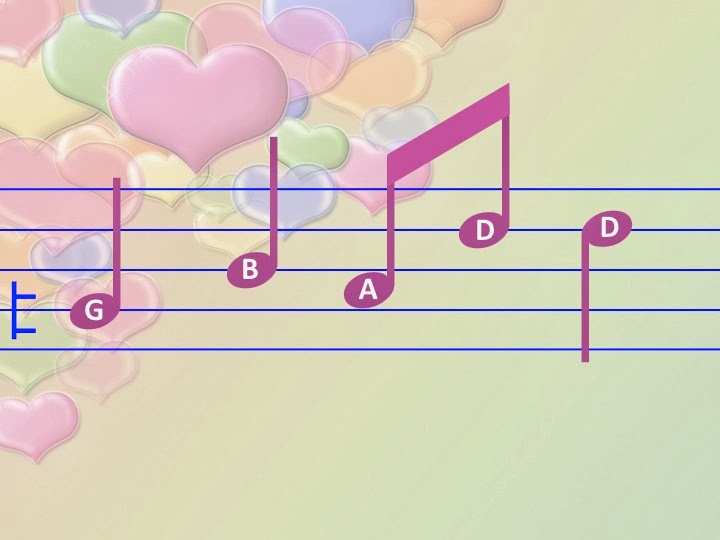
And remember I told you a while ago that reading in absolute pitch was something I was trying to have my kids do more often?  Well, here are some absolute pitch reading cards.  If your kiddos are playing recorder, this could be accessible to them if you've gotten to high D:


Here's the song sort that I'm going to be using this year with my kiddos.  You could do it with first grade with the pink and blue hearts only.  You could use it with your second graders if you've gotten to re and you using the green, blue and pink hearts.  And for your third graders, you can use all the hearts.

Basically, you can use this how ever you want to.  If you gave each of your kiddos all four of the purple hearts (the absolute pitch cards), they would put the song in order.  You can extend that and have them match the solfége (the green hearts) to the purple hearts.  You can tailor it for your students needs and what ever your assessment might be.


Remember those hearts that I found at The Dollar Tree?  You could also use that with this song as an assessment- have them write out the melody on the staff paper using the Table Scatter hearts.  The possibilities are endless!!  Please share some of your ideas with me!

If you'd like this PowerPoint and Song Sort, you can find it at my Teachers Pay Teachers store.

I hope you all had a GREAT Martin Luther King Jr. Day!!
0

Hunting for Turkeys

Warning: this idea is stolen!  I have modified this from Jeremy's post over at Kentucky Kodály.  He does a game called "Sea of Solfa"/"Catch that Tune".  I thought it would be fun to change this to work for Thanksgiving.

Here's the basic idea: two sets of students are assigned to be "hunters".  (I have two students in each set).  The rest of the students are "turkeys" and are scattered throughout the room:
Each turkey is given a turkey die-cut to hold.  Below is the set I used with my 3rd graders.  You can add the extended pentatone (I did this with 4th grade) and fa (I did this with 5th grade) or more, depending on your students' singing/reading ability:

From here there are now some options of how you can proceed:

  1. the teacher can sing a pattern, using solfége and the hunters have to go retrieve the appropriate turkeys and put them in order to match the phrase.
  2. the teacher can sing or play a pattern on a neutral syllable and the hunters gather turkeys
  3. the teacher can sing the pattern on a neutral syllable, students can write the pattern on the board and then the hunters retrieve turkeys. This is what I did, here's an example of a pattern from today (G-do):


Once the hunters think they have the correct turkeys in the right order, they play an instrument (i.e. a triangle), everyone "freezes" and reads the turkeys in the order that the hunters arranged them.  If it's correct, the hunters all pick a turkey to trade places/jobs with, a new pattern is given and play continues.

I must admit I had some anxiety with this game.  I think my main problem is I am a control freak.  When the hunters were looking for turkeys and all the turkeys were gobbling (even though they were doing it in a "quiet" manner, as we went over before the game started) my blood-pressure went up and I felt a complete overwhelming feeling of chaos.  In analyzing this, maybe it's just the nature of the game?  But there are some good points for this game: the kids got to move creatively, they had to decode melodic patterns and they did a really good job of stopping when the "cued" instrument signaled to do so.  After my Advil kicks in we'll see if I'm brave enough to try it again tomorrow!!! ;)
0

Solfa and Absolute Pitch Blocks

 Well, I "think" I have an original idea with this, but who knows.  Since school has started I feel stretched pretty thin between teaching, having a kindergartner (that attends my school), spending time with my two year old, planning a birthday party for my kindergartner and trying to get my extra-curricular choir, drum ensemble and two tone-chime choirs up and running, so it's been a little while since I last posted.  Well, without further adieu, here's my "original" idea:

Solfa & Absolute Pitch Blocks:  I bought wood math manipulative blocks from our local teacher store (Banks School Supply).  It was about $8 for a pack of 96 blocks.  I really like the wood blocks: they fit perfectly in the staves that you can pick up at your state music conferences and you can write on them easily with a Sharpie.  I decided to make do pentatonic blocks: there are two sides that have do, and one side of each of the following- re, mi, so & la.  I made enough for each student to have a set of 8 blocks.  From this, independently they can write a simple 4 beat dictation (if eighth notes are the most complex rhythmic element) or working in pairs or groups, they can do more complex patterns that contain more then 8 pitches).


After I bought the 98 wood blocks for $8 at the teacher store, I found foam blocks at the Dollar Tree.  I loaded up on these: there are four colors.  With the blue bocks, I made Absolute Pitch Blocks.  For these I used a do hexachord (that is do, re, mi, fa, so la), with G=do.  From this, the student can use them to write in both G-do and C-do and they can write the first 6 pitches that they learn to read on the recorder (I teach B-A-G first; then add high C & D and low E & D).  Here's what they look like compared to the Solfa blocks:


Now, I used a metallic Sharpie marker to write on the Absolute Pitch Blocks.  This was a PAIN! The blocks absorbed the ink and it took me more then 5 markers to complete all the blocks.  I also tried foam markers.  These were even worse.  I couldn't even finish 20 blocks with these (I did not try the Elmer's brand.  I can't remember the brand I used as I quickly returned them to the store.).  I did create some ta, ti-ti and ta rest blocks with the remaining blue blocks.  For these I used a black Sharpie.  This worked better, but the blocks still absorbed the ink.  Any hints for writing on foam are greatly appreciated!!! :)


4
Back to Top