Showing posts with label tika-tika. Show all posts

Chicken on a Fencepost

I know I say this about EVERY song I put up here, but this is a favorite.  And a gem, the kids adore it!!

Here's the song, you probably know it:


Here's the game:
2 concentric circles w/ two “foxes” on outside.
Teacher chooses 1 “gate” in each of the circles. Rubber chicken is placed in the inside circle.
Gates are closed. Foxes may watch now. Both circles sing while moving in opposite directions. On the “o” of Brownie-o” the 2 gates open forming a maze in which foxes race to grab the chicken from the middle of the center circle.

Here's the PowerPoint I've made.  Of course, it's in the "usual sequence" (sounds like a movie, maybe it's the Oscar watching that I'm doing, lol!).  I always let the sequence dictate the order of my PowerPoints.  In this case, the rhythm of the song is taught first (with the hardest element being tika-tika) and the melody second (with the hardest melodic element being low so)

Here's the lyric slide:


Beat slides:

And example of the iconic rhythm slide:

tika-tika prep slide, substituting the known rhythms and leaving the four icons representing the unknown rhythm that is four sounds on a beat:

Finally, the full rhythm of the slide (this is the first of 2 slides):

Then on to the melody slides:


Here are the preparation slides for low so:


And low so practice slides:


Absolute pitch practice:


This is available at my Teachers Pay Teachers store in PDF form.  **  The slides look a little different than above.  That fun chicken image in the background was HUGE and made the file too big so I had to take it off.  If you're really wanting that version, and purchase it, email me and I'll send you the Google Drive link for the PDF.

Side note: if you ever buy anything and would like the PowerPoint version of it (providing you have MusicEd Font) send me an email and I'll happily send it your way!!

Tomorrow I'll be posting on "Shanghai Chicken."  I've posted about this before but I have a "Scrambled Egg" game that I'll be adding that will be able for use with both "Shanghai Chicken" and "Chicken on a Fencepost" as well as other "Scrambled Egg" ideas.  I can't wait to use this one with my kiddos!!

I hope you all have a GREAT week!!!
0

King of the Mountain

"King of the Mountain" is a very fun rhythm practice game that I learned from Lamar Robertson when I very first started teaching.  Of course, I started trying to implement it without having all my Kodály levels and I have since refined the way I teach it.  

Here are the basic concepts of the game:
Formation: 
students are seated in a circle, with “King of the Mountain” cards in front of them (folded in half and propped up like a tent- this enables the student to see their card and for players on the other side of the circle to see the card as well)
Action:

  1. One student is designated the King/Queen.  The person to the King’s right is the next highest player on the mountain (one position lower on the mountain than the king); the person to that person’s right is the one position lower etc., all the way around the circle with the player to the king’s left being the lowest player on the mountain. In other words, as you progress around the circle from the king’s right, you go “down” the mountain (you get lower and lower on the mountain).  The goal of the game is to work your way up to the top of the mountain and be in the king’s position.
  2. The king starts the play by reading his/her card, with a steady beat.  Without missing a beat the king must then read another player’s card.  The player who’s card is read must then read their card and then another player’s card and so on until someone makes an error.   The rhythms on the card must be read with a steady beat and without missing a beat.
  3. If a player makes a mistake (for example, misses a beat, reads a rhythm wrong, says their card out of turn) that player goes to the bottom position on the mountain (the seat to the king’s right) and all players “lower on the mountain” that that player advance up a position.  ** THE CARDS ARE FIXED IN THEIR POSITION- THE CARDS DO NOT MOVE, only the players change position.  The king starts the play again, once everyone has changed position.
  4. The end of the game is determined by the length of time the teachers wants to designate to the game.
To make this more difficult:
  1. Have students must clap their rhythms, in addition to saying them.  This is much harder then just saying their rhythms.
  2. To “Up the Ante”, have students clap only their rhythms.  
  3. Instead of using standing cards, cut the cards in half and have the students read the cards from the floor.  This challenges students to read cards on the other side of the room that are upside down and backwards- this is a higher level thinking task.  But, this is also visually harder with large groups


As I mentioned before, when I first started I had no clue as to what I was doing.  I had every rhythm imaginable in the game and it was a mess.  I redid them a few years ago and really used them to focus on practicing a specific rhythmic element.  Those cards have been starting to  look pretty bad so I recently made new versions of the games, here are some examples of four Syn-co-pa cards:


I'm going to print them out on card stock and then they will be folded along the dotted line so that they stand up.  

You can find the following sets on my Teachers Pay Teachers page:
  1. Tika-Tika
  2. Ti-tika 
  3. Tika-ti
  4. Syn-co-pa
  5. Tom-ti
  6. Ti-tom
  7. Tim-ka
  8. Ti-kam
Additionally,  I have made some glynniss' games that I will be posting at my TpT store and will be writing a blog post about tomorrow.  If you follow Aileen Miracle's AMAZING blog, you'll see that she posted about this yesterday and she has some "I have/Who has" files at her store (and she has a freebie!).  Make sure you follow her, both on her blog and at her TpT store, she has some great ideas!!! 

Have a great weekend everyone!

4

Dinah


Surprise!!!  In my recent holiday fever I bet you thought this would be a holiday post! But it's not.  This is a post that's been a long time coming.  Back in September, my third graders learned tika-tika.  One of my favorite tika-tika songs is this one:


There are a few activities that I do with this song.  
  1. Name game: we replace "Dinah" with names of students in our class.
  2. Improvisation game: instead of "strumming on the old banjo,"we put other things
    1. the first time, we go around the circle and sing it "Name Game" style (see #1) but I change the ending to various things.  I.e.: "playing on the Nintendo," "eating a burrito," "talking on the telephone," "listening to the radio," "dancing a funky disco," "talking to your daddy-o", etc.
    2. depending on the class we might have to do it again with me modeling this.  If not, then they make up something they are doing with the only requirement being that it rhymes and they can make it fit within the beats of the song (for me, it's okay if they change the rhythm.  That's part of improvisation)
  3. Listening game
    1. Formation: standing circle with one student in the middle who is blindfolded.
    2. Once the student in the middle is blindfolded, we silently make a hole in the circle.  This is the "door" to Dinah's house.  I elaborate through a story that Dinah has a "magically musical house" because the walls sing.  All the standing students are the walls of Dina's house.  The blindfolded student must find the door to the house by walking around the inside of the circle and listening to where there is no singing.  Once they "hear" where the door is they walk towards it until they are out of the "house."  They know when they have made it out of the house because their classmates clap for them.  This is a cue for them to stop moving so they don't run into a wall or equipment and to remove their blindfold.
This year I had a new idea for Dinah's house and that was to build a wall in Dinah's house. I sent out a notice in our school's weekly announcement that the music room was collecting EMPTY SQUARE tissue boxes.  I was able to collect a lot, to date I have collected over 100.  My goal was 80 as that would give me 5 sets of 16 boxes.  I wrapped the boxes in white butcher paper (you know, that roll paper that is in your school's work room).  I then printed out the following rhythms ta, ti-ti, ta-rest & tika-tika using MusicEd font (really, I do NOT work for them, I just LOVE their product!).  I laminated these rhythms and then using packaging tape I taped them and wrapped the boxes so that each box had one of those rhythms on each side (there is NO rhythm on the top or the bottom of the box- if there was the boxes would not stack evenly).

Once the boxes were assembled, as a class, we derived the rhythm of "Dinah's House" (a.k.a. the rhythm to the song "Dinah").  Here's a picture of what that looked like:


Like I mentioned above, I've collect just over 100 boxes and my goal was 80.  Since I had 96 boxes that gave me 6 sets of 16 boxes.  The student then got into groups of 4-5 with each group getting 16 blocks.  Their directions were to build a wall of rhythm.  I didn't care what their rhythms were but they had to be four beat across and stacked 4 high.  The only other rule (besides the etiquette required with this: i.e. do not fall on the boxes, do not punch the boxes, etc.) was that before they knocked down their wall they had to perform their wall for me.

Here are a few sample walls:


This activity ending up being more fun then I ever anticipated it AND lend itself to some AMAZING teaching opportunities.  

First of all, it introduced/reinforced direction of note-heads related to note-stems.  SO many times when dealing with rhythm we write the stems up and neglect to write rhythms with the stems down.  Here's an example where they DID put a note stem going down (you'll notice that ALL the other groups have their stems going up. . . guess what I need to teach more of. ..  stems going down!):

Secondly, it was a GREAT chance for part work.  This group did it before I even asked them too- when I came over to hear their wall, they were ready to read it for me, with the boys reading one side of the wall and the girls reading the other side, AT THE SAME TIME.  As a teacher, this was A.MAZ.ING and fun to see!:

During the second lesson I encouraged all of my classes to have their groups perform both sides of the wall at the same time:

One class took the part work so far as to put all of their block together to create four walls.  They divided themselves into four groups.  Each group practiced their wall individually and then performed their wall for everyone.  After that, they tried clapping and saying all four of the walls together.  This was pretty tricky, but after a few tries they did it, they felt very successful and had a GREAT time figuring it out:

Of course this activity did produce some things I suspected.  Some groups did patterns:

Every class had at least one group that made a wall of rests:

This one was funny, it was their spin on the wall of rest:

And this group had a good time with all those tika-tikas!
This was a great learning activity for me.  It really reminded me of how much more I need to do with small group work, improvisation and composition!
9

Pumpkin, Pumpkin Extension Activity

At the end of September I blogged about the song Pumpkin, Pumpkin.  This song is great on so many levels.  It's got the mixer dance that I blogged about that I love to use as an opening activity for lessons as it gets the kids interacting with each other and building community.  (This works well for grades 1-3!).  It uses the pentatonic scale so it's accessible to read melodically for my third graders, who are always practicing reading pentatonic songs (as we prepare other rhythmic and melodic elements).  AND it uses the rhythm that I first present in third grade: tika-tika.  

Just to review, here's the song:


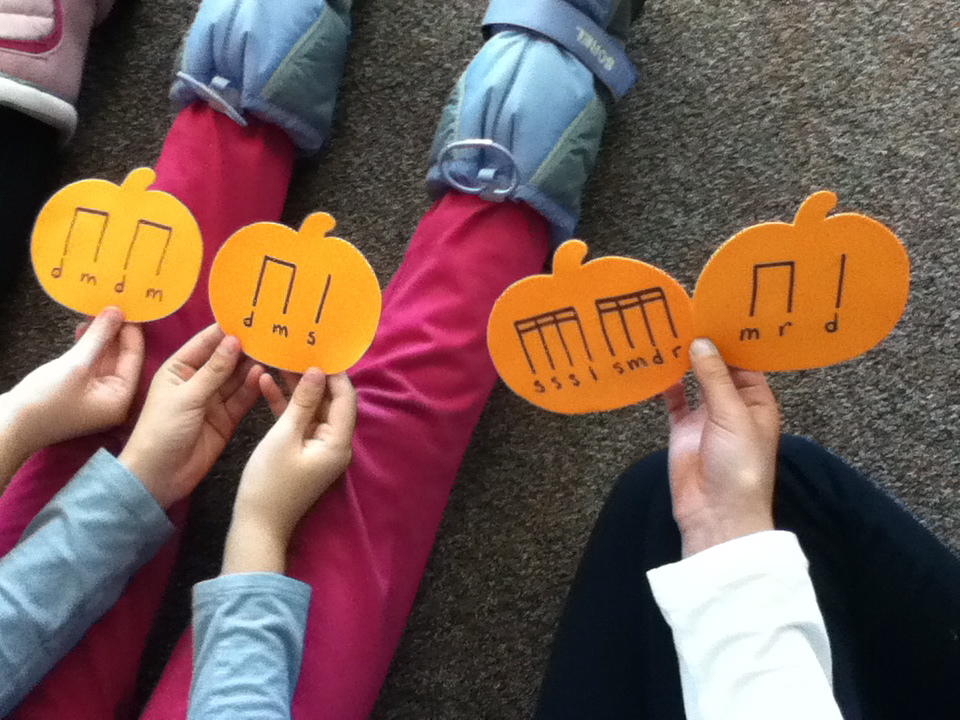
Here's a new activity that I tried this year with my 3rd graders and it was very successful.   At the Dollar Tree I found foam pumpkins.  On each pumpkin I wrote one phrase of the song and I made 9 sets (this allows the students to work in groups of 2-3).  I scattered the pumpkins all over the floor:
  

Their directions were to get into sets of 2-3 and sit along the perimeter of the room (classroom teachers love, reinforcing that math vocabulary, you know!).  Once everyone was seated, they were told that they had to gather pumpkins to create the solfa and rhythm for Pumpkin Pumpkin.  They were given one important rule: their group may only have four pumpkins in their possession at a time.  And I modeled this; for instance if Sally has 4 pumpkins how many pumpkins can John and Michael have?  Zero.  If Sally has 2 pumpkins and Michael has pumpkins, how many pumpkins can John have?  Zero.  If Sally has one pumpkin and Michael have one pumpkin, how many pumpkins can John have?  Two.)  I explained that if the four pumpkins they gather did not create the song, they would need to put the pumpkin(s) they don't need back into the "pumpkin patch" and get a different pumpkin.

Here's a couple pictures of the end result:


 I'm really happy with it for a few reasons:
  1. it got them working in small groups (2-3)
  2. it got them up and moving.  Let's face it, as Halloween gets closer, the candy-anticipation gets high and these kids need to get up and move!
  3. It challenged their problem solving skills.
  4. it was a great assessment, not only for rhythm (they were reading the song in small groups) but also for assessing the pentatone (the 2nd and 4th cards are the same rhythm, but not the same solfa)
We're off to a "Trunk or Treat" this afternoon, have a GREAT Pre-Halloween weekend everyone! :)


0
Back to Top