Showing posts with label tom-ti. Show all posts

Auld Lang Syne

Happy New Year!!!  (Okay, I think it's New Year's in Europe right now, lol!  It will be here in the states in 8 hours; 10 hours for here in Colorado).

While I'm waiting for my 2 year old to fall asleep for her nap (which is taking a VERY long time as she's highly anticipating the arrival of her cousins who are coming this evening) I will make true to my promise from yesterday: here's a freebie on my Teachers Pay Teachers store.  It's a PDF of my Auld Lang Syne PowerPoint.

I'm sure you all know the tune:


Since this poem dates back to 1788 and is from Scotland, it has many different versions in regards to the text.  I included the text that I found to be most common in the United States.  Now, just a little history for you: it was written by Robert Burns and is set to the tune of a traditional fold song: specifically Roud #6294.  Roud folk songs come from a collection of nearly 25,000 folk songs that were collected by oral traditional by Steve Roud, a former librarian in the London Borough of Croydon. Auld Lang Syne, the Scot's title which can be translated literally as "old long since," is traditionally associated with New Year's eve but is also popularly sung at funerals, graduations and other ceremonies marking a farewell or an ending to an occasion.

My 5th graders are in full-fledged tom-ti practice mode so I thought this would be a perfect way to welcome them back and dive right into where we left off.  We'll start by singing the song from these slides:


Now, since we've had two weeks off we will take a step back and review how we derived tom-ti from the tie between a quarter note and a single eighth note.  The definition of a tie (connects two notes of the same pitch) will be important later on in the PowerPoint.  (The other reason I want to review this is because in other areas of my lesson, through song literature containing games and instruments, they will be singing and physically and aurally preparing ti-tom  and we will be using the tie again to teach that rhythmic concept):


After the quick review we'll sing the song on rhythm:


This slide has the use of a slur, not only between the tom-ti but also between tas and ti-tis.  This will be something new that we will talk about: the difference between a slur and a tie (from above, a tie connects two notes of the same pitch, a slur connects two notes of different pitches).

The new few slides will be used in the following lesson to practice the extended do-pentatone.


And it's always good to have the students sing the song on absolute pitch names.  One of my New Year's Resolutions is to do a better job of having them practice this on a more daily basis. (SO much to do in 45 minutes!!!):


I wish you all the warmest wishes for a Happy and Healthy 2013!!!  See you next year! :)
0

King of the Mountain

"King of the Mountain" is a very fun rhythm practice game that I learned from Lamar Robertson when I very first started teaching.  Of course, I started trying to implement it without having all my Kodály levels and I have since refined the way I teach it.  

Here are the basic concepts of the game:
Formation: 
students are seated in a circle, with “King of the Mountain” cards in front of them (folded in half and propped up like a tent- this enables the student to see their card and for players on the other side of the circle to see the card as well)
Action:

  1. One student is designated the King/Queen.  The person to the King’s right is the next highest player on the mountain (one position lower on the mountain than the king); the person to that person’s right is the one position lower etc., all the way around the circle with the player to the king’s left being the lowest player on the mountain. In other words, as you progress around the circle from the king’s right, you go “down” the mountain (you get lower and lower on the mountain).  The goal of the game is to work your way up to the top of the mountain and be in the king’s position.
  2. The king starts the play by reading his/her card, with a steady beat.  Without missing a beat the king must then read another player’s card.  The player who’s card is read must then read their card and then another player’s card and so on until someone makes an error.   The rhythms on the card must be read with a steady beat and without missing a beat.
  3. If a player makes a mistake (for example, misses a beat, reads a rhythm wrong, says their card out of turn) that player goes to the bottom position on the mountain (the seat to the king’s right) and all players “lower on the mountain” that that player advance up a position.  ** THE CARDS ARE FIXED IN THEIR POSITION- THE CARDS DO NOT MOVE, only the players change position.  The king starts the play again, once everyone has changed position.
  4. The end of the game is determined by the length of time the teachers wants to designate to the game.
To make this more difficult:
  1. Have students must clap their rhythms, in addition to saying them.  This is much harder then just saying their rhythms.
  2. To “Up the Ante”, have students clap only their rhythms.  
  3. Instead of using standing cards, cut the cards in half and have the students read the cards from the floor.  This challenges students to read cards on the other side of the room that are upside down and backwards- this is a higher level thinking task.  But, this is also visually harder with large groups


As I mentioned before, when I first started I had no clue as to what I was doing.  I had every rhythm imaginable in the game and it was a mess.  I redid them a few years ago and really used them to focus on practicing a specific rhythmic element.  Those cards have been starting to  look pretty bad so I recently made new versions of the games, here are some examples of four Syn-co-pa cards:


I'm going to print them out on card stock and then they will be folded along the dotted line so that they stand up.  

You can find the following sets on my Teachers Pay Teachers page:
  1. Tika-Tika
  2. Ti-tika 
  3. Tika-ti
  4. Syn-co-pa
  5. Tom-ti
  6. Ti-tom
  7. Tim-ka
  8. Ti-kam
Additionally,  I have made some glynniss' games that I will be posting at my TpT store and will be writing a blog post about tomorrow.  If you follow Aileen Miracle's AMAZING blog, you'll see that she posted about this yesterday and she has some "I have/Who has" files at her store (and she has a freebie!).  Make sure you follow her, both on her blog and at her TpT store, she has some great ideas!!! 

Have a great weekend everyone!

4

Silver and Gold

What can I say, I love this song!  Sam the Snowman sings it in the old "Rudolph the Red-nosed Reindeer" show and it reminds me of watching those as a young kid.  Looking back, in the movie it really has an important message about values.  Here's the song:


I put the lyrics into a PowerPoint so the students can sing and read the lyrics:


What can I say, 5th grade is in full-fledged tom-ti practice and what's nice about them reading the rhythm of this song is that it's in 3/4 meter.  While we are practicing tom-ti now, next year I might be preparing tom-ti with 4th grade by this point (my 3rd graders are just that kind of class, they pick up things really fast).  Here are a couple samples of the preparation slides:


Since we are practicing, here are a couple of the practice slides in my PowerPoint that 5th grade will read next week:


And here's what the whole song looks like with solfa added to the slides:


I mentioned in an earlier post that my friend Tanya LeJeuene posted an article on Facebook about how neglected 3/4 meter is.  This made me think and, yes, I am guilty of this.  So I thought I would make a meter sorting game to go with this song.  Triple meter will be matched with "Silver Bells" (three syllables) and duple meter will be matched with "Gold Bells (two syllables. . . so we'll talk about how 4/4 is a form of duple meter).

Students will work in pairs and each set of pairs will have one sheet that is laminated and looks like this:
They will also have the following sheet of rhythms, cut into individual rhythm patterns.  Working with their partner, they must put all the 3/4 rhythms under the "Silver Bells" and all the 2/4 & 4/4 rhythms under the "Gold Bells".
If you are interested in this file, you can find it at my Teachers Pay Teachers store.

2

Deck the Halls

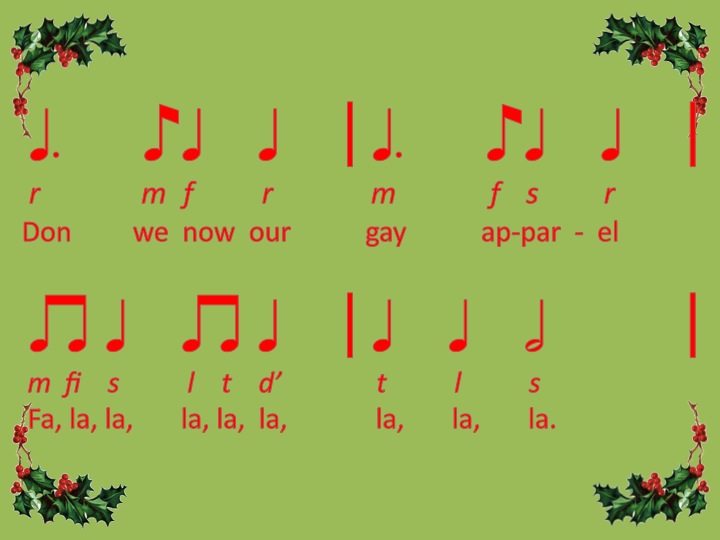
'Tis the season in my classroom for presentation and early practice of new rhythmic concepts.  My third graders will be learning ti-tika (and reading ti-tika in Up on the Housetop).  My fourth graders will be presented with syn-co-pa (which, total side note, I have started calling ti-ta-ti.  I've gone around and around about this.  I want them to see it as one rhythmic element that last for two beats with three sounds and syn-co-pa does a great job of this.  But I also want them to be able to read it in combinations where there might be a rest in part of the syncopation. i.e. Four White Horses, second measure).  And since this is my second year with these kiddos, we are behind and 5th grade will be learning tom-ti this coming week.  

Here's a seasonal example that they will use for practice in a couple lessons:


Of course there are two more verses, which are included in the PowerPoint below.  I'm also going to point out that I use the original text.  I do NOT change the word "gay" to anything else.  I think it's a non-musical lesson that they can learn.  I do not touch on the meaning that they are familiar with but do let them know the meaning of gay, in this context, means happy, festive clothing.


We then will read the following slides.  I use the tie when teaching many new rhythmic concepts.  They are first introduced to it in 2nd grade when they start reading half-note.  It's a great way of using familiar vocabulary and concepts to derive new ones.  With tom-ti we are learning the following critical attributes: it's two sounds on two beats, the first sound is longer and last 1.5 beats.


After tom-ti is presented they will then read the following slides to practice reading patterns with the newly learned rhythmic element:


I "might" come back to the solfége of this song after we learn ti, but right now we will not be using these slides.  Also note that there is an altered tone, fi, on the third slide.  I generally don't get to altered tones. . . . . if I only saw them more often!


I have created some flash-cards to practice tom-ti, all of which are from familiar holiday songs:

These patterns are all from "Deck the Halls"
 The first two patterns on this slide are from "Let it Snow" (note, it's anacrusic) and the second two are from "Holly Jolly Christmas" (the first is "I don't know if there'll be snow" (with the last rhythm changed from a dotted quarter note to a half-note to meet the reading need) and the second is "Oh ho, the mistletoe" & "Somebody waits for you")

Now, my good friend Tanya Lejeune came across an interesting article about how we tend to neglect songs in 3/4.  You can read that article by clicking here.  I agree with Tanya, that article was very thought provoking and I decided to add a few patterns in 3/4 that use tom-ti.

These patterns are from "Silver and Gold" (I will be posting a PowerPoint for this soon):

And these patterns are from "Silent Night".  This one might be difficult to use, depending on your school and your population's acceptance of religious music in your classroom:

I'm sorry to say I don't have a different game here, in fact, it's the same game that I used for "Up on the Housetop" but my 5th graders will be using this one.  Each student will receive a copy of the 16 cards below and will have to put them in the order of the song.


You can download the PDF of this file from Teachers pay Teachers by clicking here.

I do have a fun dance to use with "Deck the Halls" that I learned from another good friend, Loretta Harvey.  I've modified it a bit and you can use it to reinforce tom-ti.  I use a Glee recording called "Deck the Rooftop"  It's a mash-up of "Up on the Housetop" and "Deck the Halls".  It has a fun tempo that works really well and the kids have a BLAST with it.

Formation: contra dance formation (two lines, everyone facing a partner)
Action:
  1. First 16 beats:
    1. Stepping to the half-note, take four steps towards partner
    2. On the half note, pat both partners hands twice
    3. On the next four beats clap own hands three times to this pattern: tom-ti ta rest (I have my students say this, it reinforces the rhythmic concept that we're working on)
  2. Second 16 beats:
    1. Stepping to the half-note, take four steps away from partner (back to original spot)
    2. On the half note, step two times
    3. On the next four beats clap own hands three times to this pattern: tom-ti ta rest (again, it's good to have them say this)
  3. Third 16 beats:
    1. Stepping to the quarter note, do a right-arm swing (this is quick and is more like a running step)
    2. Stepping to the quarter note, do a left-arm swing (same as above)
  4. Fourth 16 beats:
    1. Same as the third set of 16 beats but the head couple walk behind their respected side of the set.  They end up at the bottom of the set and the rest of the dancers move up towards to top of the set as they are swinging their partners.
I also do this dance with my 4th graders, but instead of clapping tom-ti ta (rest) they will clap ti-ta-ti ta rest to reinforce their new rhythmic concept. 

I hope you all had a happy, healthy and restful Thanksgiving!!!

2
Back to Top